
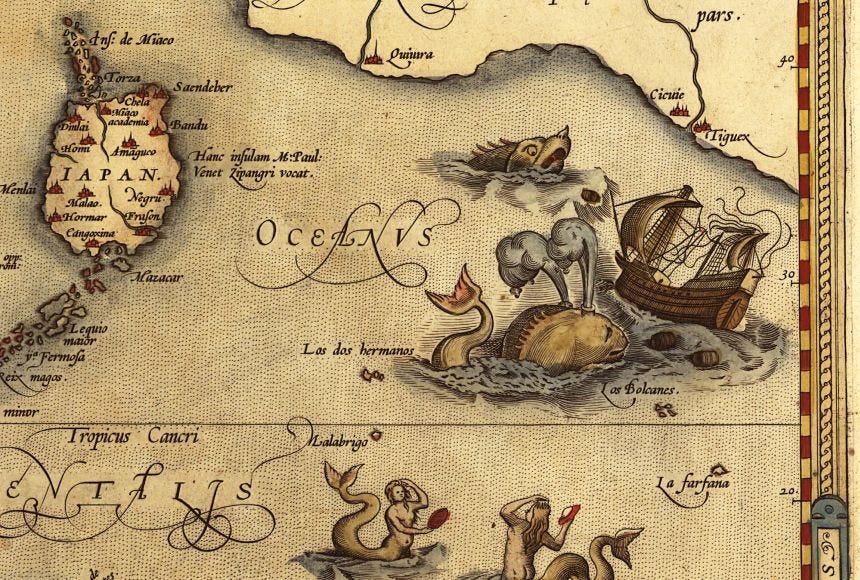
Here There Be Monsters
AI Comes for the Math World

In the 17th century, many of the finest horses came from Arabia and the Ottoman Empire. In 1686, the story goes, an English officer named Byerley captured a Turkish war horse in battle. Spotting its impressive qualities, and intuiting that its bloodline could improve English stock, he brought the horse to England, where it was bred with the best racing mares. This is the legend of the Byerley Turk and the founding of the thoroughbred racehorse. Two more foundation stallions from Arabia followed, and over the centuries, a small community of English aristocrats and officers would turn the thoroughbred into one of the best racing breeds in the world.
Today, horse breeding has been revolutionized by modern science. Yet, breeding remains an art. You can breed together the top thoroughbreds in the world for years and not produce a winner, while a champion might suddenly appear out of a lesser line. Because of this unpredictability, even today, thoroughbred breeders remain a close community, relying on intuition, science, and wisdom passed down from generations of breeders.
But why, you may be wondering, are we talking about horse breeding? And what does all this have to do with math?
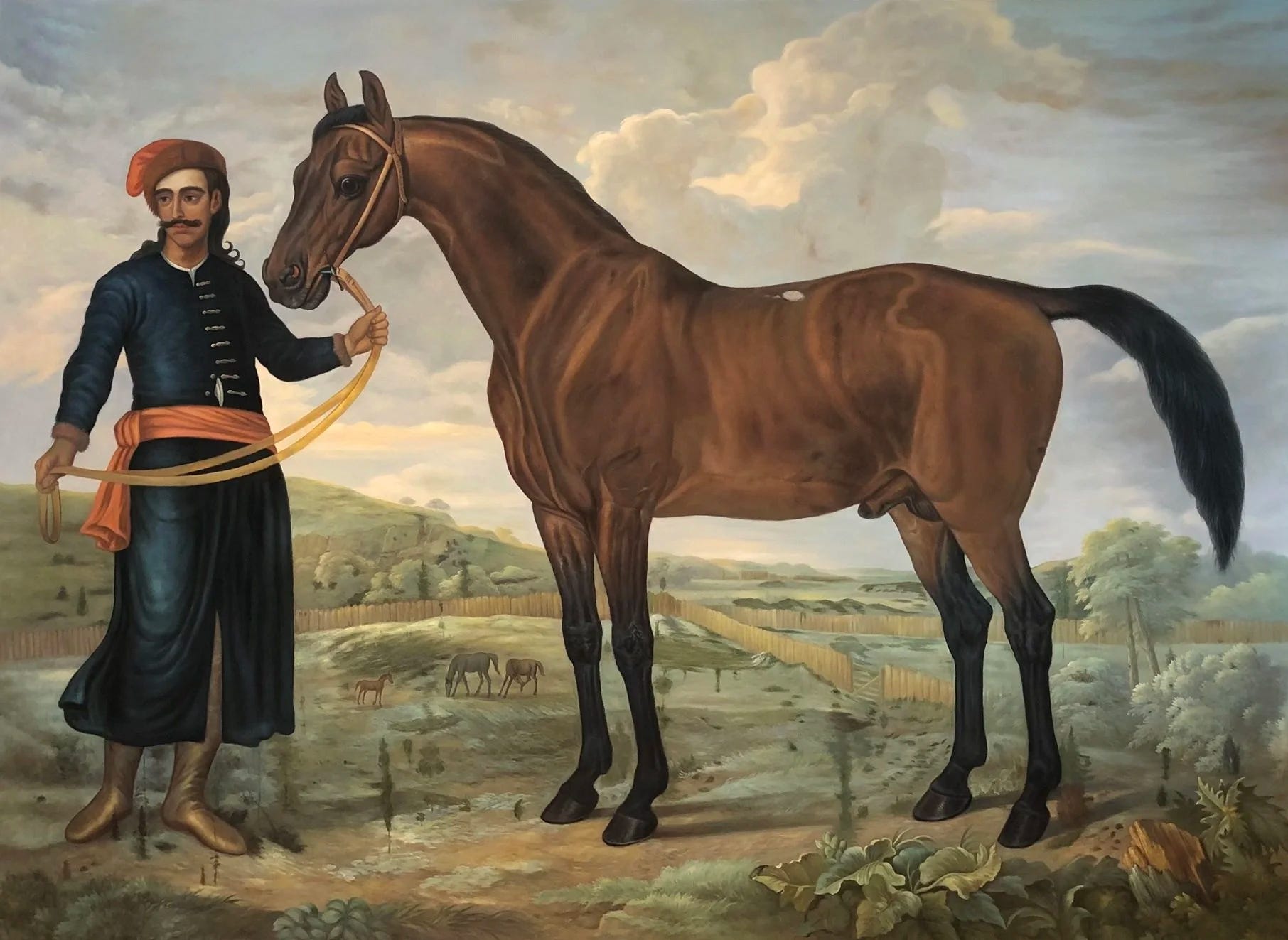
The Byerley Turk
Six Degrees of Paul Erdős
Where thoroughbred breeding has the Byerley Turk, mathematics has Hungarian mathematician Paul Erdős. It’s become a cult practice for mathematicians to calculate their degree of collaborative distance from Erdős, called their “Erdős number.” Of course, mathematicians aren’t bred like racehorses, so the Erdős number might at first appear to be nothing but a game. But it actually points to what many mathematicians believe are deeper truths.
While science has become central to horse breeding, logic has always guided math, but mathematicians aren’t just human calculators. Like horse breeding, math is a cultural practice centered in a community, one that passes down wisdom through the generations, while remaining open to new ideas. Collaboration within this community is essential to math, and Erdős was the ultimate collaborator, working with an impressively large number of other mathematicians.
Yet, like the best horse breeders, the best mathematicians also have an instinct for when they should diverge from convention to follow new ideas. Erdős was a great collaborator, but he also had a gift for unconventional moves, ones that opened up new vistas.
Or so the legend has it. But is everything I just wrote about math…actually wrong?
Paul Erdős
The Undiscovered Country
A lot of people would say that AI has neither a community, nor the capacity for intuition, yet in May, AI solved an Erdős problem. This month, a group of concerned (and, one feels, annoyed) math professors did what everyone else does these days: they signed an anti-AI Declaration. The Leiden Declaration is focused on the concerns of the math world today: LLM unreliability, shallow results, a loss of trust, tech industry intrusion and the death of peer review, as well as the AI personhood problem that we have discussed elsewhere. “(Mathematical results should be) attributable to specific authors who take credit for their discovery and assume responsibility for their correctness.” Because AI is not a person, it doesn’t have responsibilities, a professional reputation, or a stake in the community.
Yet, reading the Declaration, one can’t but sense yet another, deeper anxiety hovering over the math world.
Unplanned Obsolescence?
Might it turn out that math doesn’t actually need either intuition or community? Could AI turn out to be better than humans at math, even if it never develops any of the human qualities we pride ourselves on?
This would be a huge problem for mathematicians, because unlike horse racing, math isn’t a spectator sport. People aren’t going to pay money to watch a bunch of humans do math proofs. But it will also be a problem for humans in general, because math concepts often become the foundation for groundbreaking technologies, so the stakes are high in a way that they just aren’t for spectator sports. What if humans stop being able to understand and follow AI math? In a world where all math is done by AI, what will be the value of math to humans at all?
Maybe there will always be areas of math that can, or should, be mapped only by humans. Maybe this space will be somewhere AI can’t reach; a secret cave full of intuition, and community, and history, and culture, and the spark and magic of life. Or maybe these things only seem to matter because we once needed them for evolution. We can certainly hope not. Because otherwise, AI may simply detach math from humanity altogether, while we watch it drift away, like a child watching a balloon float into the sky.

There goes all the stuff we used to do…