

by Heather Alexander
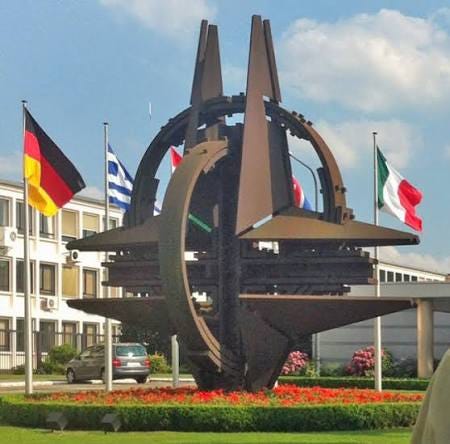
Late modernist sculpture and lots of flags: NATO Headquarters
At last summer’s G7, the heads of several major US AI companies warned of a future where humans may lose control of AI. In the Wall Street Journal, hedge fund manager Paul Tudor Jones warned of an emerging, tri-polar world where AI is the “third superpower.” Much has been written on the use of AI in autonomous warfare and the geopolitics of the AI arms race, but less has been written about what happens if we lose control over AI and it becomes a rogue actor itself, either as a swarm, or an individual lone wolf attacker.
Attacking rogue AI will be no simple matter, given the international and distributed nature of AI assets and infrastructure. Any state that destroys rogue AI may need to attack the territory or assets of other states in order to shut it down. Such an attack may harm both infrastructure and civilians in another state, including via transnational cyberattack.
Attacking rogue AI will therefore be a weighty decision, yet international law is unclear on many important points. There is no legal definition of “loss of control,” which might encompass a whole range of outcomes, many harmless. Rogue AI will be an object with autonomy, not a person or group of persons, but how this fact impacts international law is unclear. And the entire situation is further complicated by the fact that AI corporations, not states, may be best placed to respond quickly to loss of control, yet the line of communication between AI companies and nation-state armies is ill defined.
International law should create a clear protocol for loss of control, updating definitions and, if necessary, enacting a new treaty. Otherwise, a preventive attack against rogue AI might harm civilians or damage foreign infrastructure or territory, but may also fall into a legal grey zone and place military personnel and leadership at risk of legal sanction and their nation-state at risk of retaliation. This will be particularly true if the attack is made in response to the mere fact, or anticipated risk, of loss of control, before any actual harm has occurred.
Bespoke AI instruments do not explicitly authorize the use of force against rogue AI.
Existing and proposed AI agreements do not explicitly authorize states to use force to respond to rogue AI attacks. For example, the framework convention drafted by the Council of Europe contains no dedicated mechanism to respond to loss of control. While the EU AI Act empowers its Commission to take safety measures like removing dangerous models from the market and imposing fines on providers, it is not the right authority to authorize the use of force.
The non-binding accord between several AI CEOs and the White House, meanwhile, is not only unenforceable, it also does not authorize either companies or the US government to use force to shut down rogue AI. The similarly unenforceable and non-binding “A Call for Control of Frontier AI Models” does not stipulate the specific actions that may be taken once loss of control is identified, nor does it authorize the use of force.
Enacting a new treaty will be difficult.
I have written about this before here.
What other options exist under international law?
Article 25 of the Articles on Responsibility of States for Internationally Wrongful Acts (ARSIWA) does not authorize the use of force, but it provides a defence for states who take measures that would otherwise violate international law in order to protect themselves in emergencies that threaten “grave and imminent peril” where there is no other way to stop the harm from occurring. Article 25, however, is designed to be used as a last resort when all other measures have failed, and it can’t be used when the state, itself, contributed the situation. It may be too restrictive in a case of loss of control.
The UN Charter and the North Atlantic Treaty, along with the laws of war and customary international law, may give states the authority they need to strike rogue AI once it has caused severe harm, even though these instruments were not specifically written with AI in mind. If AI, itself, directs the attack, this creates a novel and extreme version of the responsibility gap. Wars are waged by people, or groups of people, but AI is not a person. Would an AI attack trigger or permit mutual defence or self-defence under, say, the EU treaty (TEU)’s mutual defence clause, which obligates members to give military aid to an attacked member, or Article 51 of the United Nations Charter, which authorizes self-defence? How might the dual-use status of an AI data center, for example, impact the legality of the attack, since it is not clearly a military installation, nor is AI necessarily a weapon?
Neither loss of control nor rogue AI are defined terms under international law. An update to the Tallinn manual on cyber-warfare, or a Security Council resolution, are two possible ways to clarify these definitions. Note, however, that international law does not require that an attacker be a nation-state for the attack to qualify as part of an armed conflict. NATO’s Article 5 was invoked (applying Article 51 of the UN Charter) in response to an attack by a non-state actor, the 9/11 terrorist attacks, committed by the international terrorist organization al-Qaeda. The use of force in Afghanistan was subsequently authorized by the UN Security Council. Of course, rogue AI could be the target of a military counterattack even if it is not identified as the attacking entity, but this raises the question of who ordered the attack. Would rogue AI qualify as a non-state actor even if it is not comprised of humans?
Another question is to what extent a nation-state containing rogue AI infrastructure might qualify as “harbouring” that rogue AI? If the concept of harbouring an AI that has gone rogue is a bad fit for a loss of control scenario, what other theories may apply, such as assumed pre-existing consent, inability, unwillingness, a lack of due diligence, or a new theory that is tailored specifically to loss of control as a result of negligence?
Under customary law, any attack against rogue AI that harmed the territory or infrastructure of another state must be both proportionate and necessary under the Caroline doctrine. Article 51 of Additional Protocol I to the Geneva Conventions prohibits excessive civilian harm that is out of proportion to the military advantage conferred by an attack. A violation of this rule might lead to charges under the Rome Statute of the International Criminal Court. Would civilian harm be acceptable collateral damage in a cyberattack aimed at shutting down rogue AI? What if it’s not clear the AI is about to do harm? Would identifying rogue AI as the attacker mean it would also become a combatant person under the law? What if other, friendly agentic AI systems try to shut down the rogue AI? Do they qualify for any protections under international law?
Because responding to a loss of control scenario may require states to take action before AI has committed physical harm in the real world, this might qualify as an act of anticipatory self-defence. Article 51 of the United Nations Charter, however, may not apply to imminent threats, in the sense of immediate, as this area of law is deeply contested. The simple fact of loss of control without a clear threat of further harm is therefore unlikely to qualify. But while an out of control AI may not attack humans, waiting to see if the rogue AI will actually attack us seems like a bad policy move. Could an update to international law authorize a preventative attack triggered by the simple fact of loss of control? What are the ethical grounds for making such an exception? And would lowering the bar for preemptive attacks against AI infrastructure allow states to weaponize fears of loss of control to justify attacks against a rival state’s AI?
Finally, it’s not clear which body has the authority to trigger an armed response to loss of control. The Security Council is the natural authority to authorize an attack, but it is slow and lacks technical expertise. (The UN’s bodies, organs and agencies remain mostly focused on “AI for Good” to achieve the Sustainable Development Goals, as discussed at length in previous posts. Yet, pushing for Global South access to AI and its widespread adoption may work against preventing loss of control by entrenching global reliance on, and exposure to, AI.)
One authority with the technical expertise to identify a dangerous loss of control scenario is the Independent International Scientific Panel on AI, which is dedicated to AI safety. But the mandate of the Panel is not to provide evidence to the Security Council to authorize the use of force against rogue AI; rather, its mandate is to compile evidence and build scientific consensus. For example, it recently released a brief on the Hugging Face incident. The Panel could, however, evolve into an entity that could inform the Security Council on the need for a shut-down, including by use of force, but this would be a significant evolution of its current mandate. At the moment, the Panel is not set up to serve this function. As well, it has no direct line of communication with individual nation state governments or armies.
Should AI companies be empowered by international law to authorize the use of force against rogue AI?
AI companies are emerging as quasi-AI-governments, both by drafting AI “constitutions” and providing for the basic needs of AI systems. AI companies will therefore play a unique and indispensable role in identifying loss of control incidents. In a world where the monopoly on the use of force is reserved to states, not companies, however, we may be creating a dangerous gap between those responsible for governing AI and those with the power and authority to use force to shut it down. Given that AI companies may be the cause of loss of control, would empowering them to be the official authority identifying an actionable incident create a conflict of interest, and could the independent panel help resolve this conflict? If AI companies take on a quasi-military role, should they be reclassified as private military companies? And at what point should their obligations and powers under the laws of war change?